Saturday

The most-used nouns: no. 007 PARTE

Girasoli (sunflowers) image by Marco Monetti on Flickr as seen on Via Optimae, www.viaoptimae.com
image by Marco Monetti on Flickr
"Adoro i girasoli. Sanno sempre da che parte voltarsi."
(English translation at the bottom of the post!)

In this series, we're covering the most used nouns in the Italian language 
(I sostantivi più utilizzati nella lingua italiana)


In case you missed it… 


Numero 7 è…..

 parte (la)

a versatile term that is used similarly to the English equivalent "part", let's look at some usage and examples:

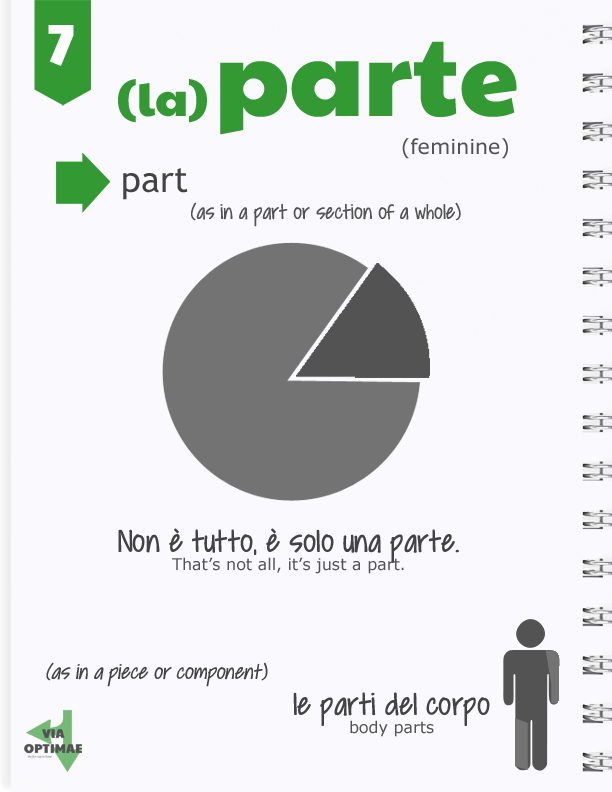
parte, la — part, definition examples illustration left, Via Optimae, http://www.viaoptimae.com/2014/08/the-most-used-nouns-no-007-parte.html


parte, la — part, definition examples illustration right, Via Optimae, http://www.viaoptimae.com/2014/08/the-most-used-nouns-no-007-parte.html


*not available on mobile devices, please try on a regular computer!
ITALIAN: The most-used nouns digital magazine, i sostantivi più utilizzati from Via Optimae, http://joom.ag/2tOX


You'll often hear it in the following…


far parte di - to be part of, belong; faccio part di un gruppo di giovani professionisti; lui invece non fa parte del gruppo; on Via Optimae, http://www.viaoptimae.com/2014/08/the-most-used-nouns-no-007-parte.html


fare la parte di - to play the part of "Giovanni fa la part di Romeo", on Via Optimae, http://www.viaoptimae.com/2014/08/the-most-used-nouns-no-007-parte.html


mettere da parte - to put aside "Metto da parte dei soldi", on Via Optimae, http://www.viaoptimae.com/2014/08/the-most-used-nouns-no-007-parte.html


See more cartoons and illustrations as well as listen to songs that feature the word "parte" in the newly updated digital magazine (pages 62-77):


Can you write a sentence using the word parte? Or maybe you can find a quote or aphorism that uses it? Comment below! (or on Facebook if you prefer)


Quote translation:
I adore sunflowers.  They always know which way (towards which part) to face.


Happy studying!
Alex on www.viaoptimae.com


Vuoi far parte di Via Optimae?
and get social!
Alex at Via Optimae on TwitterPinterestFacebook


Previous posts in this series:

Sunday

C'è , Ci sono…

(There is  ,  There are... in Italian)

C'è , ci sono There is and there are in Italian, Via Optimae, http://www.viaoptimae.com/2014/08/ce-ci-sono.html


You're lounging on a boat… gently cruising through the crystal blue waters of the Mediterranean, taking in the many sights and sounds of the Aeolian Islands off the coast of Sicily.  You decide to write a letter describing everything you see. 


Salina, Isole Eolie, image via turismoeolie.com as seen on Via Optimae www.viaoptimae.com
image via Turismo Eolie
It's all so beautiful, that only poetic Italian will do, and you start by telling of the volcano in the distance:

"There is… There is…" 

Hmm.  Maybe you'll start with the boats you see behind you?

"There are… There are…"


"Ah! If only I'd studied 'There is' and 'There are' in Italian!" you think to yourself.


You wake suddenly and realize you're not on a boat in the Mediterranean and that knowing "There is" or "There are" isn't the only thing standing between you and poetic greatness in any language.

Still, you're reading an Italian lesson and that's a good start! So you decide to seize the day and learn these invaluable forms so that no matter where you find yourself, you can describe your surroundings in beautifully poetic Italian.

To talk about what there is/there are… Italian uses the pronoun CI and the third person forms of the verb ESSERE:


ci + è = c'è there is ; ci + sono = ci sono there are, by ab for Via Optimae, http://www.viaoptimae.com/2014/08/ce-ci-sono.html

As you can see, when ci and è are used together, they get contracted into c'è.  C'è (there is) is used when talking about just one thing:


C'è un vulcano.
There is a volcano.

And ci sono (there are) is used when talking about more than one thing:

Ci sono tre barche. 
There are three boats. 


It isn't always necessary to specify the exact number, as long as it's plural, you use Ci sono…


Ci sono barche. 
There are boats. 


Ci sono tante barche. 
There are so many boats. 


Ci sono delle barche.* 
There are some boats. 


Related lessons:

Pluralization, talking about more than one thing… 
* The Partitive Article, how to say "some"


Negation:

You can also add the negation word "Non" before each to describe what isn't there:

Non c'è un vulcano. 
There isn't a volcano.

Non ci sono barche. 
There aren't any boats.


In Questions:


C'è un gatto?
Is there a cat?
No, non c'è un gatto.
No, there isn't a cat.


Quanti gatti ci sono?
How many cats are there?
Ci sono due gatti.
There are two cats.


Ci sono gatti?
Are there cats?
C'è un solo gatto.
There is only one cat.


Putting it all to use:

Take a look around where you currently find yourself and practice describing what there is….


C'è un computer. Ci sono libri.
There is a computer. There are books.  

Or instead of just listing, you can ask and then answer your own questions, like: 

(1) Che cosa c'è?
What is there?


C'è un computer. 
There is a computer.


Ci sono dei* libri. 
There are some books.


* Review the The Partitive Article or how to say "some", if desired, or just exclude the partitive and say "Ci sono libri — There are books"


(2) Quanti* [       ] ci sono? (How many [    ] are there?)
*If the noun is feminine, it becomes Quante

C'è un solo computer. 
There is only one computer.


Ci sono quattro libri. 
There are four books.


If you're missing the vocabulary or just want to be reminded— try using Via Optimae's free label pages to label a wide variety of items around your home and use them as a basis for practicing all of the above!

More practice:
Try describing what you see in this picture (another beautiful island off of Sicily— Pantelleria)  Not sure about the vocabulary?  Mouse over the green dots to see words displayed in Italian and English!

C'è and ci sono a Pantelleria, a thinglink "touch" image by Alex for Via Optimae, www.viaoptimae.com


Hai capito? (Got it?)  

"Like" Via Optimae on Facebook and post your own photos and descriptions of "Che c'è" (What is there?) in your surroundings!


For written practice, print the C'è | Ci sono worksheet on page 14 of the Beginner's Italian Workbook and fill-in both the "notes" section and the quick exercises that follow! 


ITALIAN: Workbooks Beginner's Workbook, Part One, from Via Optimae, www.viaoptimae.com

 —be the first to know about new lessons & worksheets! {Subscribe here!} 

{Additional practice:  The final exercise of the Partitive Article Worksheet features C'è and Ci sono and can be found on page 15 of the Italian Basics digital workbook} 

Happy Studying / Daydreaming! 

These final weeks of summer and my mind is on Italian island hopping.  Check out Conde Nast Traveller's Guide to the Aeolian Islands for your own travel inspiration!
Alex on www.viaoptimae.com


Panarea, Isole Eolie by Florent Le Gall on flickr as seen on www.viaoptimae.com
Panarea, Isole Eolie


All lessons in the Beginner's Italian series:
  (1) How Italian verbs work, (Intro to verbs & grammar terms)
  (5) La negazione - Negation
  (6) Ogni quanto? Quante volte? (Adverbs of frequency)
  (7) C'è & Ci sono — CURRENT PAGE


Potrebbe pure interessarti….
ITALIAN: The Basics Series, starting with:
(01) Indefinite Articles (How to say "A/AN" in Italian


See also:

Frasi celebri su Via Optimae

Frasi celebri su Via Optimae
Acque del sud (To Have and Have Not) original: "You know how to whistle, don't you, Steve? You just put your lips together and… blow."